Showing posts with label homophobia. Show all posts

Saturday, May 23, 2020

Masculinity The Chocolate War

Soooo I'm thinking this is going to be my last post analyzing The Chocolate War???? After this, I don't think I really have anything more to say. I copied and pasted all my posts into a google doc (including pictures) and it is 54 pages and 16689 words so needless to say I have said a lot about it. Well, for this post, I'm just gonna go through some elements that I've neglected in previous posts: the role of sports and of masculinity (and discussing power and control a bit more because that ties into masculinity).

CW for cisnormative language and homophobia


Let's take a look at good ole Trinity. The two biggest sports at the school are football and boxing, and ironically enough those two sports are total opposites from each other. Football is a team sport- it requires a group of young men to work together to overcome an opposing team. The game is slow paced, requires strategy and planning, as well as speed and strength. Boxing on the other hand is a one-on-one type sport, mano a mano, just two dudes being guys in the ring beating each other up. It's quicker paced, doesn't require teamwork, and may require some kind of strategy? I don't know, I don't know jack shit about boxing. Either way, it also requires speed and strength like football but is overall more intense. Both sports are highly dangerous, and players can often suffer from concussions and CTE. Moreover, both sports are seen as highly masculine. Sure, there's female boxers out there and I guess a female football league that I found on wikipedia but I've never heard of it before so whatever, I'm just trying to say that these are traditionally masculine pursuits more so than some other sports.

One interesting thing about The Chocolate War is that almost every major student character is on a sports team. Jerry, Goubert, Carter, Janza are all on the football team and Carter also boxes. Even Obie used to play football and regrets not going out for the team at Trinity. The only student that stands out is Archie, who hates sports and considers athletes to be stupid (side note, he doesn't exercise and eats chocolate like every day, kid's gotta be rotting from the inside). I've mentioned in previous posts that Archie is different from the other boys in that he's not a traditional manly man. He represents something scarier to the boys of Trinity than a typical violent bully- he's something that they can't understand and can't fight their usual way. Sports are pretty straightforward- go use your strength to crush the other guy, pretty straightforward. But you can't just go beat up Archie (well, you could but you'd have to answer to the other Vigils and you don't wanna go toe to toe with Carter). He's intelligent, a creature that uses wits and manipulation.


This failure of the traditional masculine fighting style is represented in the fact that Trinity's sports haven't won in ages, which is costing the school funding. Society at large values masculine pursuits such as sports and when schools fail to deliver, they are punished. It is this failure of masculinity kicks off the plot that turns a high school into a war zone.

However, this failure is also the source of strength in overthrowing the Vigils. Throughout the story, Jerry rejects the masculine ideals of violence and holds a peaceful protest. To the other boys, he seems emasculated (going back to my previous post talking about conformity where Jerry appears as the opposite of what young men should strive to be) and getting beat up and called gay is the straw that breaks the camel's back. He gives into violence but becomes further emasculated from losing the fight. Of course, I can't exactly blame him for giving in. What was he supposed to do? Just take the harassment and the beatings? Jerry was stuck in a lose-lose situation and was going to be emasculated either way.


This isn't the Vigils first time emasculating someone. They do the same with Goubert, though it takes far less to break him. Let's take a look at Goubert; he is "fifteen years old and six-one-and-a-half", he is highly athletic- an amazing runner and promising young football player- but he is also timid and sensitive. Already we see a dichotomy between masculine and feminine traits in him. Being summoned and given an assignment by the Vigils is what first breaks him. In chapter 8, immediately after saying his age and height, the narration remarks that he is "too old to cry" and that "he was ashamed and disgusted with himself." We've all heard the old adage 'boys don't cry', and Goubert has been firmly indoctrinated into that belief. His main motivation is the fear of being further emasculated by both the Vigils and Trinity, and this is what leads him to quitting the football and track teams and to stop giving his talents to Trinity, which he believes is "evil". When explaining his reasoning, Goubert tells Jerry that he "was crying like a baby" and that he sees "what [the Vigils are] doing to [Jerry]", and though Jerry doesn't quite understand it Goubert insists that Jerry give up on his rebellion before being further emasculated like he was.


Jerry too falls for the old boys don't cry belief, as I mentioned in my previous post there's a quote in the book where the narration states that "Jerry wished he could be as strong as his father, always in control, masking his sorrow and grief." Jerry pushes back against being emasculated in his own way- he doesn't ever show that the Vigils' harassment is getting to him. He remains 'strong' and doesn't ask for help from any adults in his life. Granted, no adults at Trinity would be able to help, but he makes no effort to tell his father or look outside of Trinity for support. Now, I'm sure that it's common for victims of bullying to be ignored by any authority figures, but regardless Jerry is avoiding telling any adults about it so as not to appear weak.

Now, Archie stands out compared to the other boys- he rejects traditional masculinity, he's the one doing the emasculating and doesn't fear it. Or does he? I think he actually does, but in a different way from the other boys. His fear lies less in being made effeminate or gay and more in being made into a child again. He often calls people 'kid' even if they are around the same age as him, and is unhappy being "a senior in a lousy little high school". Obie mocks Archie by having him meet int the gym knowing that Archie detests it, but it's not really successful in emasculating him. The only person who really intimidates him is Brother Leon, the one who is really in charge and a reminder that Archie is just a teenage boy. Archie himself is being emasculated and made to feel powerless so he exerts his own power on others to feel like a man again.

The movie depicts all this and adds in a homoerotic element as well. I discussed this more in depth in a previous post, but I'll briefly go over it here too because it plays into emasculation. While handing out assignments, Archie asserts his power by invading their personal space, touching them, and overall acting sexually aggressive to scare them. Naturally they are afraid of this, anybody would be, but it adds another later because to these boys, a man showing sexual interest in them puts them in a woman's place.


In the end, there's a grand show down in the form of a boxing match, bringing everything back round to sports. Archie's usual tactics of emasculating boys aren't working on Jerry, so he just falls back on a straightforward fight to emasculate him. In the book it works, in the movie it doesn't, but either way violence and conventional masculinity win.

And I think that's all I've got. I've said all I can about The Chocolate War and don't have anymore posts planned for it (until I get the sequel at least). Stay tuned for another blog post about something else.


Thursday, May 14, 2020

Catholicism, Conformity, Control, and Capitalism in the Chocolate War

Somebody let SparkNotes know because my analyses are a million times better than theirs.

So let's talk about the four C's of The Chocolate War: Catholicism, Conformity, Control, and Capitalism.

Help Make Wonderful Memories

So, as you may have noticed, the story takes place in an all boys Catholic school called Trinity. For a bit of background, author Robert Cormier attended a Catholic school himself in his hometown of French Hill, Massachusetts. He really went with a 'write what you know' moment so The Chocolate War takes place in a Catholic school and I don't remember if they specifically say it's Massachusetts but they mention going to Boston at one point and some of the characters in the movie have Massachusetts accents so I think it's safe to say it's in Massachusetts.

I'm going to be honest, I'm not an expert in Catholicism. I'm Greek Orthodox. But my mom was raised Catholic and went to Catholic school, and I actually attended a Jesuit university for two years so I'm not totally in the dark. There's one thing my mom always said- "if you want to ensure that your kids won't be Catholic when they grow up, send them to Catholic school". Needless to say, she did not enjoy it. I can see why Catholic school might be awful for teenagers. They have to wear uniforms, they have to bow not only to regular school authorities but also to religious authorities, they are taught from a purely Catholic point of view as opposed to a diverse education, and I'm not sure but I think they have to attend mass??? which is super boring but they don't mention it in the book and one scene in the movie might be at mass??? so I'm not sure if they actually do (my roommate just told me that they definitely do [Edit: just noticed that in chapter two they mention going to chapel]). Either way all these things are the exact opposite of what teenagers yearn for- they want to be free to express themselves, to learn about the world around them, and to not be told what to do. I'm not trying to diss Catholic schools or anything, I'm just saying in the context of this book they might have a somewhat negative impact on students. Of course, public high schools have issues like this too but we're not talking about public school.

The makeup of Trinity is pretty homogenous, and this is especially apparent in the movie. All the students are white and male, and a majority are Catholic (it is mentioned at one point that there are several non-Catholic students). If the last names are any indication, there are two main ethnic groups at the school: French and Italian, and then there are some others from like I don't know Scotland? Ireland? and I also have no clue where the name Janza is from, maybe Czech? And the name Costello manages to be both Irish and Italian at the same time but more likely it's just Irish and also I can't imagine an Italian dude named Archie. Also, side note, why did Cormier decide to name this terrifying, cold and calculating villain 'Archie'? That's so goofy. Why not just give him a friend named Jughead while you're at it. Whatever, I'm not gonna argue with a dead dude. Okay so basically what I'm trying to say here is that the school is not diverse.

In the film, the only people of color we see are Lisa's two friends. Otherwise, we get scores of young white boys in the same uniform and several monks in the same brown robes. The only individuality they're really allowed is their hairstyles and their coats (and Archie has a seriously nice coat).

Love that 80s hair
So here, Catholicism and conformity go hand in hand. Early in the story when Brother Leon interrogates Bailey in front of the class,  he admonishes the other students for allowing it to happen and compares it to Nazi Germany. I discussed this scene a bit more in my character analysis of Brother Leon a couple posts back, but here I'm going to talk about it more in relation to conformity. Comparing the class to Nazi Germany is a rather serious accusation and sets the story up to parallel the rise of fascism. The Nazi's wanted to create a totally homogenous, unified Germany by getting rid of all those they felt were undesirable- and this actually included Catholics. Of course, Catholics weren't persecuted the same way Jewish or Romani people were, but many high ranking Nazis and Hitler himself were strongly anti-Catholic. Moreover, the USA has held anti-Catholic sentiments since the days of the colonies and even in the 1960s there was a strong pushback against JFK because he was Catholic. Naturally, a Catholic school in the 1970s (1980s in the movie) would be sensitive to this type of persecution and conformity in the general population, which is what makes it ironic when the school recreates it themselves.

Let's go back to a previous post where I analyzed Jerry Renault. There, I discussed how Jerry was moved by a line from the poem "The Love Song of J. Alfred Prufrock" written by T.S. Eliot. In one of Jerry's classes they had to study Eliot as he was a prominent Catholic poet and that's how Jerry discovered his work. The line "do I dare disturb the universe" is one factor that inspires him to rebel against the school and the Vigils. Here, Jerry reflects true Catholic principles and the teachings of Jesus Christ- he peacefully stands up to authority and fights for change. It is also here that the school fails the teachings of Christ- they become the persecutors. It is cruelly ironic for the school that they are the ones who teach Jerry to rebel when they teach him about Eliot and when Leon gives the 'lesson' about allowing persecution. In essence, Trinity is run by a hypocrite in the form of Brother Leon. He condemns conformity but then enforces it.

Jerry's refusal to conform at first causes some students to view him as a symbol for rebellion, but soon they turn on him due to an intensive marketing campaign by the Vigils. One question asked by another student to Jerry in chapter 30 reveals the reason for the sudden change in the students' attitudes-

"you think you're better than we are?"

How come Jerry doesn't have to do his part? How come Jerry gets to receive the benefits of going to Trinity without doing any work? How come Jerry isn't a team player? The Vigils paint Jerry as a smug, lazy dissenter who thinks he's better than everyone else. They also accuse him of being gay, further playing into the homophobic beliefs held by the students and the Catholic church itself. And it's effective. He's no longer a symbol of revolution but rather a symbol of all that any hard-working, honest, red-blooded American man should hate.

Social distancing
This leads us into talking about control. The whole story is about control and fighting each other for power. As I mentioned earlier, the Catholic school system controls these boys' education and forms of self expression, they are not allowed much freedom. Last week, my coworker was talking to me about her upbringing in the Catholic church. She went to Catholic school k-12th and even stayed at a convent upon graduating to consider becoming a nun. She told me that the system is quite repressive and that repression is dangerous because eventually the darker side of human nature will be forced out. At Trinity, this dark side takes the form of the Vigils. When you control every aspect of a teenager's life they will rebel in dangerous ways to try and take back even the smallest portion of some control. Since the Vigils are just teenagers and don't have any power over their own lives they form a secret society to have power over all the other students. It is the fault of adults that create a repressive, unsafe world for teenagers that leads to them doing horrible things to one another and quite literally starting a war.

Alright, we've covered Catholicism, conformity, and control but where does capitalism fit into all of this? Well, in my opinion, capitalism is the root of almost every problem in the story. I don't know what Robert Cormier's political opinions were and honestly I don't really care to know because this is my analysis, but capitalism is a driving force for the conflict of the story.

What kicks off the main plot of The Chocolate War? Money. As mentioned in my character analysis of Emile Janza, most of the parents and alumni of Trinity are not super wealthy and usually private schools rely on the donations of alumni along with the costs of tuition. However, Trinity and many other private schools are struggling to raise enough money to cover their costs but the families of students cannot afford any tuition increases. The school has an annual chocolate sale to raise funds- fine, that's all good- but this year Brother Leon increases the prices and the number of chocolates that need to be sold. If capitalism and money itself didn't exist, this problem would be nonexistent. Unfortunately, capitalism does exist and is what spurs on Brother Leon.


Now, I don't really like to look at The Chocolate War as one big metaphor (though Cormier himself said that he 'regarded the school as a metaphor for the world' in an introduction he wrote for the 1997 edition) but I do like to look at it as a reflection and consequence of the world. I could call Brother Leon a metaphor for the government and capitalism, the Vigils as possibly the military or police, Jerry as dissenters and revolutionaries, etc. But the world is too complex for such simple metaphors. Instead, I prefer to look at Brother Leon as something created by capitalism- a capitalist. His motivation is power and money and he relies on the labor of students for it. He buys the chocolates with money that he wasn't supposed to use, bumps up the price, has the students sell them, then takes the fruits of their labor and gives them nothing in return. Naturally, this stresses the students out but they see no way out of the sale for fear of repercussions. Brother Leon enlists the help of the Vigils for the sale with the promise of more power, which is the one thing they crave. Or at least what Archie craves. In the world at large, the one thing that compels people to uphold capitalism is the hope that one day they will be one of the lucky ones that holds power and riches even if they have to step on others to get there. Capitalism is so ingrained in American culture that it seeps through and infects even small schools like Trinity. Even the Catholic church itself isn't safe- one of the biggest criticisms I've heard is that it's run like a business.

Capitalism is a social construct. Capitalism is a mass hallucination that can be broken at any time. Of course, it's not that easy to destroy, even on a small scale like at Trinity. What is required to end this hallucination is the workers joining forces to overthrow their rulers. At Trinity, the students can't truly overthrow Brother Leon and the school himself, but they can overthrow the Vigils. The exact number of Vigils is not given, but it can't be that many considering it's an exclusive club and the overall population of the school is around 400 students. Unless the Vigils have over 200 members (unlikely) then they are vastly outnumbered by the other students. Why don't the other students just stop going along with their assignments? Sure, the Vigils got some muscle like Carter but there has to be other strong students that could take him on. Unfortunately, every time there is a dissenter he is quickly crushed. Several students talk of revolt and openly admire Jerry, but the Vigils resort to violence to quell any uprisings, much to Archie's displeasure. This proves to be effective- it's violence that ends Jerry's revolt in the final showdown. In chapter 32, after Jerry is beaten up by the children that Janza hires, the narration says "funny, somebody does violence to you but you're the one who has to hide, as if you're the criminal." Not only is the fear of violence what keeps the students docile, but also the fear of emasculation from said violence. It's quite simply embarrassing for a teen boy, a football player at that, to be seen bruised from losing a fight. That's why when offered the chance to get revenge on Janza and prove himself to be a, for lack of a better term, 'real man' he jumps. None of the other boys want to be subjected to that and therefore fall in line with the school and the Vigils, much like how the threat of violence is what keeps capitalism from falling.


However, it's not just violence that keeps capitalism alive. As I mentioned before, capitalism is deeply ingrained in American culture. Many citizens don't need to be forced into upholding it, they have been indoctrinated into believing it to be the best system. They think that socialists are lazy moochers, they think that communists are authoritarian dictators without realizing that those at the top of the capitalist pyramid are both- much like Brother Leon is both. Archie manages to indoctrinate the students into this way of thinking so they begin to think of Jerry as the enemy.

In the end, the chocolates are all sold, the money is raised, and the Vigils with Archie at the helm have more power than ever before. Then how come none of them are happy? The only real winner is Brother Leon- he makes his money and impresses the school board, paving the way for him to become headmaster next year. Obviously Jerry isn't happy- he loses the war. In the order of the Vigils, president Carter is miserable and has been for the past two years from having to deal with Archie's 'psychological crap', his 'silly games', and acting as 'the big shot as if he ran the show.' Carter hates his role in the club. Obie also hates his role, he hates playing second fiddle to the cruel and demanding Archie. Even Archie himself is miserable. In his character analysis I discussed how he is drained and hollow from creating new assignments constantly, how he's being used by those around him, and how truly lonely he is. He didn't win, he just thinks he did. In capitalist American society, the only ones who are truly happy are those at the very top. The rest of the population can think that they're happy, that they're winning, that they're lucky to live in the land of the free and not in some apocalyptic socialist nation, but they're really not. The soulless pursuit of money and power destroys any sense of human empathy and can never bring true happiness. Archie can have all the power he wants but he will never be truly happy.

In the end, Trinity is not Nazi Germany- it's the United States of America.


_

Okay that's it for this post. I've got a couple more posts planned for analyzing The Chocolate War (I wanna talk about the role of sports + masculinity and talk about Jerry's dreams in the movie), so stay tuned.


Saturday, May 9, 2020

The Chocolate War is kinda gay??

Okay, I'm gonna talk mostly about the movie here but also a little bit about the book.

CW for homophobia and cisnormative language

Anyway, I watched the movie twice. Once, I was alone. The second time, I was showing it to my roommate with my other roommate poking her head in every so often. The main thing that both of them had to say about the movie: "It's gay".

When I watched it alone, I only sensed gay vibes in like one scene that I'm gonna be talking about. However, my roommate looked at every scene and thought it was gay, even when they were just standing there. She's a lesbian so she's probably better at picking that stuff up than me. Of course, it's a movie about an all boys Catholic school with a majority male cast so it's bound to seem slightly homoerotic.
Okay a little more than slightly

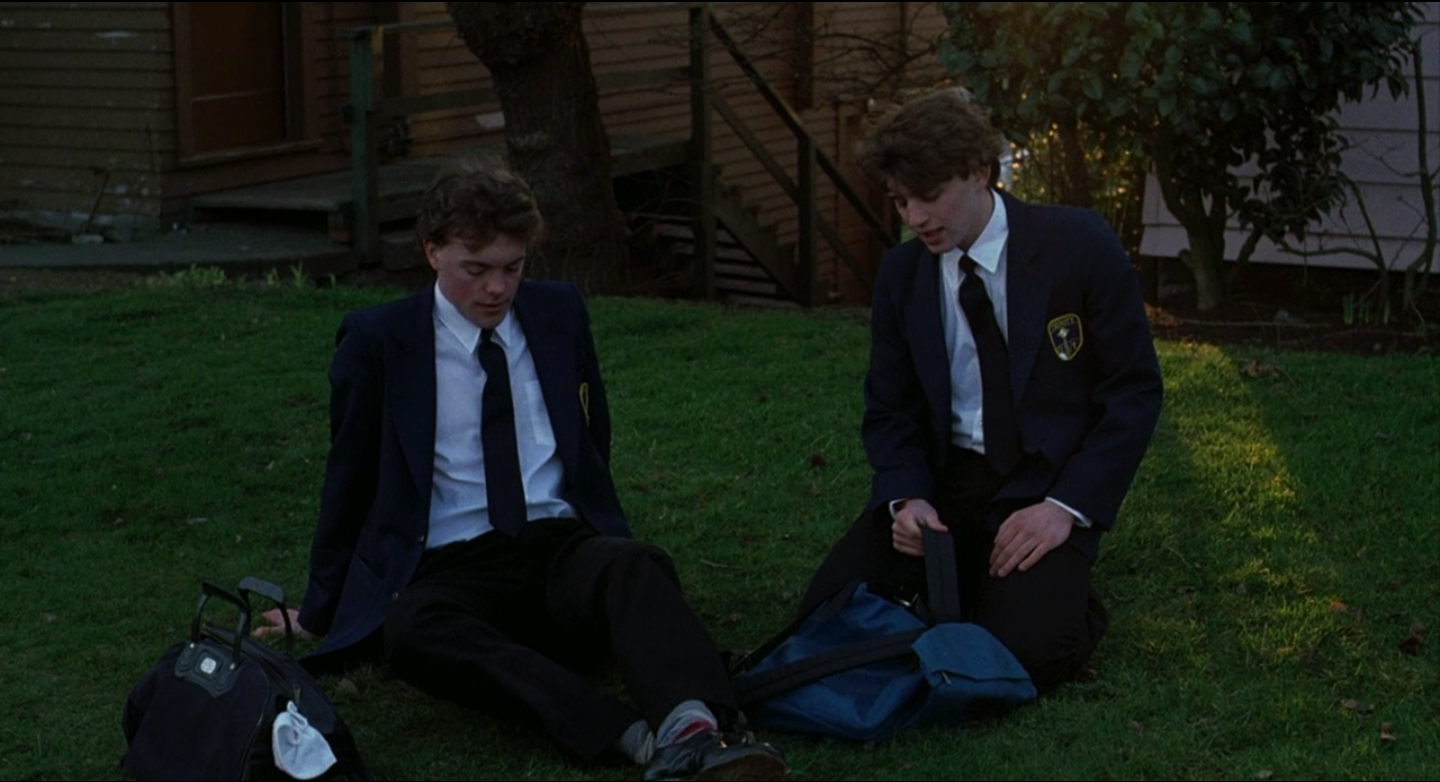
(For those that have not seen the movie, the kid on the right is not Porter. That is Jerry Renault and Porter is just out of frame. I'm saying this so you won't be confused when I'm posting more screenshots).

Are any of the characters actually gay? I don't know, and author Robert Cormier is dead so we can't ask him. When I was reading the book it did not seem homoerotic at all, but I'm also not the best at picking up on gay tension and my roommate wasn't reading over my shoulder to tell me. It should also be noted that in the book it is mentioned that Archie is interested in girls, and both the book and movie show that Jerry too likes girls. However, the book and movie are not one and the same so I can't really use that in my analysis of the movie. 

If we're gonna talk about homoeroticism and the use of sexuality in The Chocolate War (1988) then the first thing I want to talk about is the girl that Jerry is interested in named Lisa. She's not a major character and only has a few lines but she is important in analyzing Jerry's psyche. Near the beginning of the movie she talks to Jerry as he is waiting for the bus. She calls him out for staring at her and her friends, taunts him about how he's not really living while he just stands there and takes it. However, her taunting doesn't seem cruel but rather flirtatious and Jerry is charmed. He later dreams about kissing her and this cements her as clearly an object of his affections. She represents freedom and rebellion to Jerry, something he lacks in his life, as well as illustrating how Jerry is coming of age and developing interest in girls. The most important takeaway I want you to get from this paragraph is that she uses taunting to express sexuality and Jerry responds well to it.


Later in the movie, this scene is sort of reversed and acted out between Archie and Jerry. Archie has taken Jerry to a Vigils meeting to interrogate and intimidate him into selling chocolate. Archie is very touchy-feely with him, and gets all up in his personal space. Like when he was being taunted by Lisa, Jerry again just sits there and takes it despite being visibly uncomfortable. Here, Jerry is being taunted again, but it is the opposite of how Lisa did it. She taunted him upfront to express her sexuality and interest in Jerry. Here, Archie uses sexuality and an interest (probably feigned) in Jerry to taunt him. If that makes sense? 


This scene isn't so much saying that Archie is gay but rather showing how he uses threats of sexuality to intimidate his targets. These are Catholic teenage boys in the 1980s and have been indoctrinated into homophobia. Nothing is scarier to them than a gay man expressing interest or the thought that they themselves might be gay. Archie understands this and uses it to his advantage and to exert his power over his classmates. Further demonstrating Archie's understanding of homophobia, he has Janza use homophobic slurs to enrage Jerry enough to get him to agree to a fight. 

He's left handed, I thought Catholic schools didn't allow that??
And it seems that Archie gets into Jerry's head by doing this. A little later in the movie, Jerry has a dream about the people he knows with their voices switched around. The first person he sees is Archie speaking in Lisa's voice. Maybe I'm reading too much into it, but it doesn't feel like a coincidence that Archie, a boy who used sexuality to taunt Jerry, is speaking in the voice of a girl that Jerry is sexually/romantically interested in. The words "you're missing a lot of things, Jerry" are spoken, an echo of what Linda said to him earlier. It seems to imply that the wires got crossed and Jerry may be having confused sexual feelings for Archie as well and is 'missing out' by refusing to explore that. I'm gonna talk more about this specific dream later in the next post I write. The movie doesn't hint at anymore interest from Jerry's side after this scene but I thought it was worth mentioning. 
Idk why the subtitles say 'woman' when it's clearly Lisa but whatever

That brings us to the next question: Is Archie gay? My roommate certainly thought so. My answer is that I don't know. For these next few points keep in mind that certain stereotypes about gay men are often used in media and does not reflect real life. One stereotype about gay men is that they are effeminate. There is absolutely nothing wrong with being effeminate, but it is often mocked and used as shorthand to imply a man is gay. Archie doesn't display typical 'masculine' traits. He disdains sports and enjoys eating chocolate, which is typically stereotyped as something women love. He is polished and owns a really nice coat, showing that he takes pride in his looks as opposed to his more 'rugged' classmates. He shuns violence and can't hold his own in a fight, preferring psychological warfare instead. This doesn't automatically make a man gay but this is a movie written by people that may hold the idea that it does. There are other small things that might imply Archie to be gay, such as earlier in the movie telling Carter to sit back and let 'some pretty little freshman' sell his chocolates for him. Moreover, late in the movie Archie calls Jerry up on the phone and speaks to him without a shirt on. Though their conversation isn't sexually charged this still adds a layer of homoeroticism to the scene. Of course if you read my last post then you know it seems like Archie only owns the one outfit so maybe he just didn't have another shirt to put on.

Regardless of whether or not the writers intended for Archie to be gay he is still not traditionally masculine which is a common theme in media for male villains. Of course, he's not exactly overly effeminate and still has what some consider to be 'masculine' qualities of being powerful and intimidating. Likewise, Jerry our hero is not exactly a super macho rugged man though he is a football player. He's quiet and generally a peaceful guy until he's pushed too far. It should be mentioned that both boys display a mix of 'feminine' and 'masculine' traits. 

Does that mean that The Chocolate War is homophobic? I don't know. Maybe. It wouldn't be the first time a film gave the villain gay undertones. Archie isn't the only villain however, as Carter, the president of the Vigils, is still a bad guy and more conventionally masculine. Brother Leon is also a villain and I wouldn't classify him as being either particularly masculine or feminine but I'll talk more about him in the next post. On the hero's side is Roland Goubert who, despite being a football player, is a sensitive and gentle soul and a loyal friend to Jerry. Moreover, it can be argued that Jerry has bisexual feelings as well. There's no clear cut answer as to what the director was trying to say. 

The book lacks this homoeroticism, or at least I didn't notice any when reading it. It is stated that Archie likes to pick up girls but never has the time and when Janza asks him if Jerry really is gay Archie assures that he's not because if he was he wouldn't get so worked up at being accused of it. I don't know where his logic is coming from but whatever. Either way, Archie is in tune with how homophobia works and uses that to his advantage. 


Look how nice Archie's coat is though

But yeah that's it :) stay tuned for the next post